
What Are the Alternatives to Focus Groups?
Focus groups can be costly, time-consuming, and restrictive. But what other options exist for creative testing, also called creative pretesting or concept testing, when you need to know before you launch?
The better question: why are we still treating delayed feedback as discipline?
Takeaways
- Traditional alternatives like A/B testing and surveys often inherit the same constraints as focus groups.
- Next-gen alternatives use audience science, AI, and machine learning to remove many of the challenges faced by focus groups and their traditional alternatives.
What About A/B Testing and Surveys?
Surveys and A/B testing have long existed as quick focus group alternatives for testing creative, but they’re not without risk.
- Both expose your intellectual property to real people, potentially before it’s ready or before you’re confident in it, the exact thing that testing your creative is meant to protect.
- Both delay feedback. You have to launch, collect responses, and wait for the results to mean something.
- And both can be costly when deployed at scale. Surveys in particular can rack up the bills when deployed widely.
In short, though they’re meant to be lighter-weight than focus groups, they often reproduce the same problem: you spend time and money to learn what you needed to know earlier.
Next-gen alternatives, conversely, move creative testing upstream. They give teams a way to pressure-test ideas before the market becomes the judge, jury, and invoice.
What Are Creative Prediction Models?
Advanced prediction models use machine learning to forecast how creative is likely to perform before it goes live.
This grouping of models presents a wide variety of solutions to the same problem. These tools are generally powered by machine learning processes, allowing for faster, more quantitative readouts than traditional testing methods can usually provide.
The function of these tools varies. Some use emotional prediction to determine creative effectiveness. Some focus on predicting memorability. Some, like Soulmates.ai’s answer, focus on past social media metrics as a predictor of creative effectiveness.
Soulmates.ai‘s tool is called the Foresight Engine. It uses machine learning to predict post performance across social media channels. It functions by analyzing historical posts from a specific account alongside broader platform performance patterns. This large-scale analysis of hundreds of thousands of posts, with particular attention to past engagement on your own accounts, allows the Foresight Engine to provide predictive scores for your post’s engagement metrics.
On top of this, the Foresight Engine also provides qualitative feedback drawn from its analysis of your post against top performers, and an estimated earned media value score. The point is simple: score the creative before a dollar moves.
These models are great at doing what they’re designed to do. If you’re looking for emotional tracking, seek out a model that has it. If your creative is designed for social media, seek out the Foresight Engine.
What Is AI Audience Modeling?
AI audience modeling, sometimes called AI personas or virtual audiences, is perhaps the most prevalent form of focus group alternative, and for a reason. Audience models allow you to communicate with audience representations at a speed traditional research cannot match. It’s worth noting, however, that not all AI audience models are built the same.
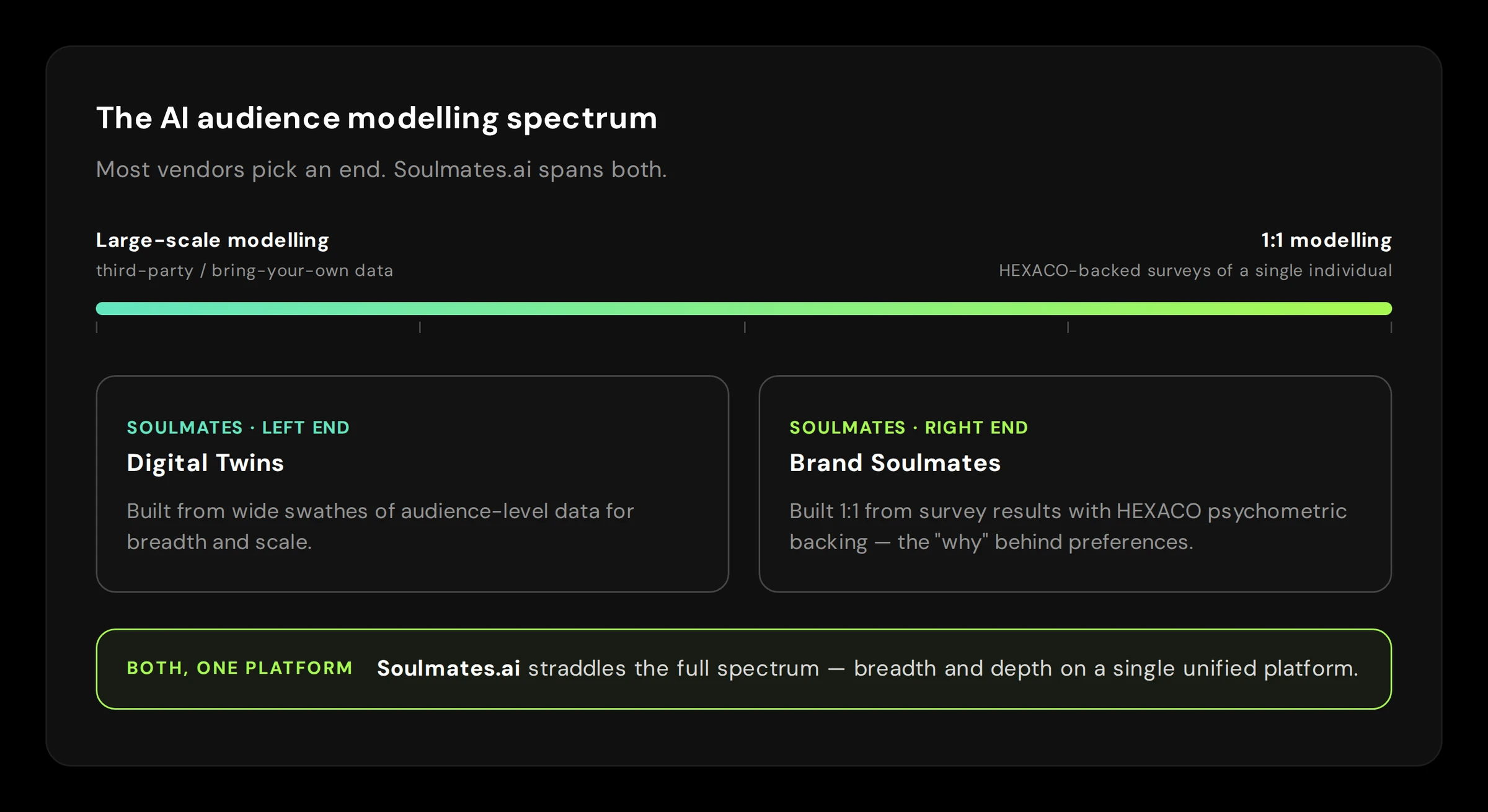
Within this sprawling category, definitions fall apart. Titles and phrases mean different things to different vendors, and it’s not possible to interrogate the worth of a model through its title. Commonly, there are two major divides within this category: audience-level models and 1:1 models.
The way to tell what you’re dealing with is by following the data. Vendors behind population-level or large-scale audience models usually model their audiences on third-party or bring-your-own data. These models are generally good for speed, scale, and directional learning, but they do not provide the same reliability as a properly sourced 1:1 model grounded in real respondent data.
Soulmates.ai offers two distinct audience-model options: Digital Twins built from wide swathes of audience-level data, and Brand Soulmates built from 1:1 survey results complete with HEXACO psychometric backing. Digital Twins are best for fast iteration, directional insight, and scaling an audience model within hours. Brand Soulmates are the higher-reliability option: 1:1 audience counterparts grounded in real audience data, validated at an average 93% fidelity against holdout data. We reach that 93% by holdout testing every Brand Soulmate, comparing its answers against the matching real respondent’s; it agrees a little more than nine times out of ten, which is our statistical average for accuracy across the Brand Soulmates product.
These AI audience models are generally optimized for creative use. On the Soulmates.ai platform, for example, you can A/B test creative, pressure-test copy, and dig into the “why” behind audience reaction using psychometric data.
As opposed to the specialized use of creative prediction models, these AI audience models are flexible research instruments, allowing for varied and multifaceted use cases that can mirror or go beyond what you might do with a real respondent.
Which Alternative Is Right for You?
The eternal question: what should I do? Or maybe the less eternal question: what focus group alternative should my organization pursue?
Here are the facts:
- In terms of cost, next-gen models largely win when deployed at scale.
- In terms of speed, next-gen models are hard to beat. Creative prediction models and audience models can deliver testing insights in seconds.
- In terms of IP safety, next-gen alternatives help prevent unfinished creative work from being judged as an approved asset by real people.
If you’re trying to decide between the two types of next-gen alternatives, Soulmates.ai gives you both inside BrandOS. Use the Foresight Engine when you need to score social creative before launch. Use Digital Twins when you need fast, directional audience learning at scale. Use Brand Soulmates when the decision carries real weight and the insight needs stronger confidence.
The old tradeoff was speed or depth. Modern alternatives let teams test creative quickly without sacrificing rigor, so the decision no longer has to wait until after launch.
FAQ
Can AI audience modeling accurately replicate focus groups?
Yes. Brand Soulmates are validated at an average 93% fidelity score and are designed as a fast-paced focus group alternative when teams need higher-confidence insight grounded in real audience data.
What's the difference between Soulmates.ai’s Digital Twins and Brand Soulmates?
The difference is in the data and the level of confidence required. Audience Digital Twins are meant to represent large swathes of your audience. They are best for speed, scale, and directional learning. Brand Soulmates are detailed representations of your actual audience members. Each Brand Soulmate is modeled on a real, consenting individual and validated for higher-reliability decision-making.
What's the difference between a creative prediction model and AI audience modeling?
Though both use advanced AI technology, the difference is in what they’re designed to do and how they’re designed to do it. AI audience modeling replicates your audience at varying scales. Creative prediction models use data and machine learning to provide specific analysis of your creative assets.
What is HEXACO and why does it matter?
HEXACO is a six-factor psychometric framework that’s more detailed than the industry-standard Big Five model. In AI audience modeling, HEXACO is used in Brand Soulmates to dig into the underlying psychology at the core of your real audience.