
How Brand Soulmates Extend the Shelf Life of Audience Research
Lauren Arevalo | May 22, 2026 9:00 PM UTC

Overview
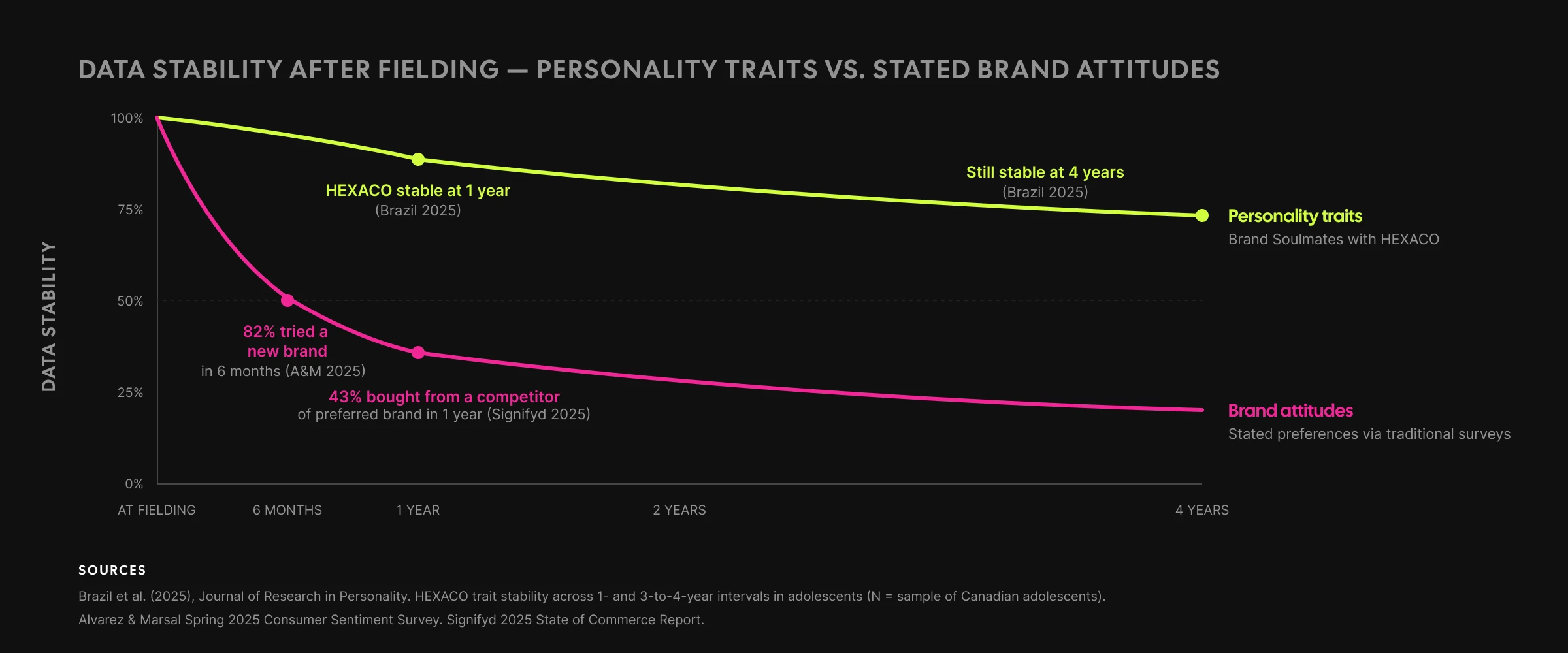
Brand attitudes are valuable, but they have a shelf life of about six months before they drift far enough to limit the reliability of older research. Soulmates.ai extends that window two ways: by anchoring Brand Soulmates to HEXACO personality traits that stay stable for years and support a strong best guess on urgent questions, and by recruiting real audiences who can be re-queried on the data points that drift faster.
Key Takeaways
- Within six months of fielding, 82% of consumers have tried at least one new brand, and within a year, 43% have bought from a competitor of their preferred brand. Stated brand attitudes are not durable enough to anchor multi-year decisions.
- HEXACO personality traits are durable in a way that stated attitudes are not. Recent research tracking adolescents found HEXACO scores stable across one-year and four-year intervals, with adult populations showing similar or stronger stability.
- Brand Soulmates are 1:1 digital twins anchored in HEXACO, which keeps research fielded once useful for years and supports a strong best guess on urgent questions even between fieldings. Because the audience is real and recruited, the same Brand Soulmates can also be re-queried for fresh data on the points that drift faster.
Why Does Audience Research Go Stale?
Brand attitudes are a valuable read on the consumer landscape, capturing what people say they like, what they bought last quarter, and how they feel about a recent campaign. The signal is useful, reliably fielded, and easy to convert into reports. However, it is also the signal that drifts fastest, which is what creates the shelf-life problem in time-boxed audience research.
The Alvarez & Marsal Spring 2025 Consumer Sentiment Survey of more than 1,600 U.S. consumers found that 82% had tried at least one new food or beverage brand in the prior six months, and the Signifyd 2025 State of Commerce report found that 43% of consumers had bought from a competitor of their preferred brand within the past year. The data here is clear: new entrants, retail-media saturation, social-driven discovery, and unrelenting price sensitivity have shortened the window during which a brand-attitude reading is reliable. Six months from fielding, data is suggestive; twelve months, approximate; two years, theatrical.
What Stays Stable About People?
Personality stays stable in a way that stated attitudes do not. The HEXACO model (Honesty-Humility, Emotionality, Extraversion, Agreeableness, Conscientiousness, Openness) captures six fundamental dimensions of how people experience the world, make decisions, and respond to risk and reward, and unlike brand preferences or recent purchase behavior, HEXACO scores are robust across time.
Brazil et al. (2025), published in the Journal of Research in Personality, tracked HEXACO scores in adolescents across one-year and three-to-four-year intervals and found that stability held across the full measurement window. The 2022 meta-analysis from Bleidorn and colleagues, drawing on samples totaling more than 178,000 individuals, found similar patterns in the closely related Big Five framework, and adult personality is generally even more stable than adolescent personality. Both are stable enough to anchor multi-year research.
What this means in practice is that the deep architecture of who someone is, including how curious they are, how conscientious, how risk-tolerant, and how social, does not move much from year to year. The brands they buy, or whether they prefer a new app or an old one might change, but the personality from which those preferences emerge stays intact. That is the foundation Brand Soulmates are built on.
How Brand Soulmates Are Built Differently
A Brand Soulmate is a 1:1 digital twin of a real, recruited consumer, built from first-party data and anchored to a HEXACO personality profile. Each Brand Soulmate carries a verified fidelity score, with the platform averaging 93% behavioral fidelity, meaning predictions of how that twin will respond closely match how the real person actually responded.
The architecture matters is what distinguishes Brand Soulmates from other approaches. Each Brand Soulmate is an individual, a 1:1 digital twin of a real consumer anchored to that person's actual HEXACO profile and validated against their actual behavior, which is a different category from composites built from demographic averages or qualitative archetypes.
The practical implication is that a brief can be brought to life against an actual recruited audience rather than approximated against a fictional representative. Because the audiences are real and recruited, the same Brand Soulmates can be queried again as new questions emerge, which keeps the data points that drift fastest from going stale on you. And because the HEXACO foundation underneath stays stable for years, the trait architecture keeps doing useful work even between fieldings, which means urgent research questions that come up in the time before a re-query can be answered anchored to validated traits rather than to demographic averages or guesswork.
What This Means for Marketing Decisions
Several practical consequences follow from this architecture.
You can ask new questions of the same population on demand. Because Brand Soulmates are built from real recruited audiences with maintained relationships, the same cohorts can be queried with new survey questions about new campaigns, new product launches, and new cultural moments without commissioning new fielding. You can also re-ask the same question over time, fielding it to the same cohort at six months, twelve months, and eighteen months to get a longitudinal read on how your specific audience is shifting rather than relying on industry averages or generalized sentiment trackers.
Because each Brand Soulmate's trait profile stays stable for years, responses to a new campaign or cultural moment can be read from existing data, anchored to validated trait architecture rather than to demographic averages or guesswork.
You can compare across time without confounding personality drift with attitudinal drift, so when a Brand Soulmate's response to a new campaign differs from their response to a campaign six months ago, you can attribute the difference to the campaign rather than to the possibility that the underlying respondent has fundamentally changed.
You can absorb the cost of research over a longer time horizon, because a research investment that holds up for two years is functionally a fraction of the cost of one that has to be re-fielded every six months. And you can act faster on emerging cultural moments, because when a campaign launches or a competitor pivots or a category gets disrupted, you do not need to wait six weeks for new fielding to read your audience.
When to Re-Field Anyway
The shelf-life argument is real but has limits, and there are conditions under which a structural refresh is genuinely warranted rather than reflexive.
Re-field when a respondent is likely entering a major life-stage transition, such as new graduate to first job, single to married, no kids to first child, or working parent to empty-nester. The HEXACO foundation may stay stable through those transitions, but the surrounding context that shapes purchase decisions changes meaningfully enough to justify a new layer of data on top of the existing trait anchor.
Re-field when a category is genuinely new to the respondent, because Brand Soulmates anchored before someone became a parent will not have the contextual layer needed to predict baby-product purchase decisions, even though the underlying trait foundation remains accurate. The trait foundation is portable across categories, but the category-specific layer is not.
Re-field when major competitive entrants reshape the choice set, because the HEXACO architecture predicts how someone weighs trade-offs but cannot predict reactions to brands that did not exist when the data was fielded. The general principle is that the foundation stays while the layers refresh.
FAQ
How long does research from Soulmates.ai actually stay useful?
The HEXACO foundation stays useful for years, with multi-year stability well-documented in the personality literature, and the layers built on top of that foundation (recent media habits, category-specific knowledge, current campaign reactions) refresh on a shorter cadence as needed.
What is HEXACO and why does it matter for audience research?
HEXACO is a six-dimensional personality model (Honesty-Humility, Emotionality, Extraversion, Agreeableness, Conscientiousness, Openness) derived from cross-cultural lexical research, and it outperforms the older Big Five model on certain prediction tasks, particularly anything involving ethics, integrity, or risk behavior. For audience research, HEXACO functions as a permanent anchor, because a consumer's HEXACO profile stays similar across years while the attitudes built on top of it (brand preferences, media consumption, category opinions) drift faster.
What's the difference between a Brand Soulmate and a traditional persona?
A traditional persona is typically a composite, a fictional representative built from demographic averages and qualitative archetypes, whereas Brand Soulmates are 1:1 digital twins of real individuals, each anchored to that individual's actual HEXACO profile and validated against their actual behavior. Personas describe a category of consumer in the abstract, while Brand Soulmates predict how specific consumers will respond.
How is fidelity measured and verified?
Fidelity is measured by comparing a Brand Soulmate's predicted response to the actual response of the real consumer it twins, and Soulmates.ai averages 93% behavioral fidelity across the platform, with each Brand Soulmate carrying its own visible fidelity score that can be filtered alongside HEXACO traits and demographics.
Can I query existing Brand Soulmates for a new campaign without commissioning new research?
Yes. Soulmates.ai builds Brand Soulmates from real recruited audiences with maintained relationships, which means the same cohorts can be queried again as new questions emerge. The platform supports two re-querying patterns: asking existing cohorts new questions about new campaigns, products, or cultural moments, and re-fielding the same question at intervals to track how your specific audience is shifting over time. And for urgent questions where re-fielding isn't practical, the HEXACO foundation provides a strong best guess on its own, because each Brand Soulmate's stable trait profile is enough to predict responses anchored to validated trait architecture rather than to demographic averages. Reach out for a walkthrough of how clients are using these capabilities together.