
How to Create Messaging That Resonates With Every Personality Type
Lauren Arevalo | January 16, 2026 8:26 PM UTC
Overview
The same product benefit can be framed in radically different ways and the right frame depends on your audience's personality. This article serves as Part One of Two in our "HEXACO For Marketers" series, where we illustrate how to use the six-factor HEXACO model to develop messaging that actually connects with your intended audience.
Key Takeaways
- Same benefit, different frame. "Security" appeals to high Emotionality; "performance" appeals to low Emotionality. Same product, different psychological entry point.
- Honesty-Humility is highest stakes. It's the strongest predictor of brand trust. Misalignment damages the relationship, not just the campaign.
- Tone matters as much as content. High Conscientiousness needs precision; high Extraversion needs energy. Match delivery to personality.
- Focus on 2-3 dimensions. Identify which dimensions matter most for your category and audience, then develop messaging that hits those notes.
Generic messaging is a tax on your marketing budget. When your message doesn't match your audience's psychological profile, you're paying for impressions that bounce off instead of landing.
The solution isn't louder campaigns; it's smarter framing. The HEXACO personality model gives marketers a research-validated framework for understanding how different audiences process information, evaluate claims, and make decisions. And unlike demographic targeting, personality-based framing addresses the actual psychology driving consumer behavior.
The Six Dimensions That Shape Consumer Response
HEXACO identifies six personality dimensions that emerged consistently across lexical studies in multiple languages. Each dimension represents a spectrum and people score somewhere along a continuum. Where they fall on that spectrum predicts how they'll respond to different messaging approaches.
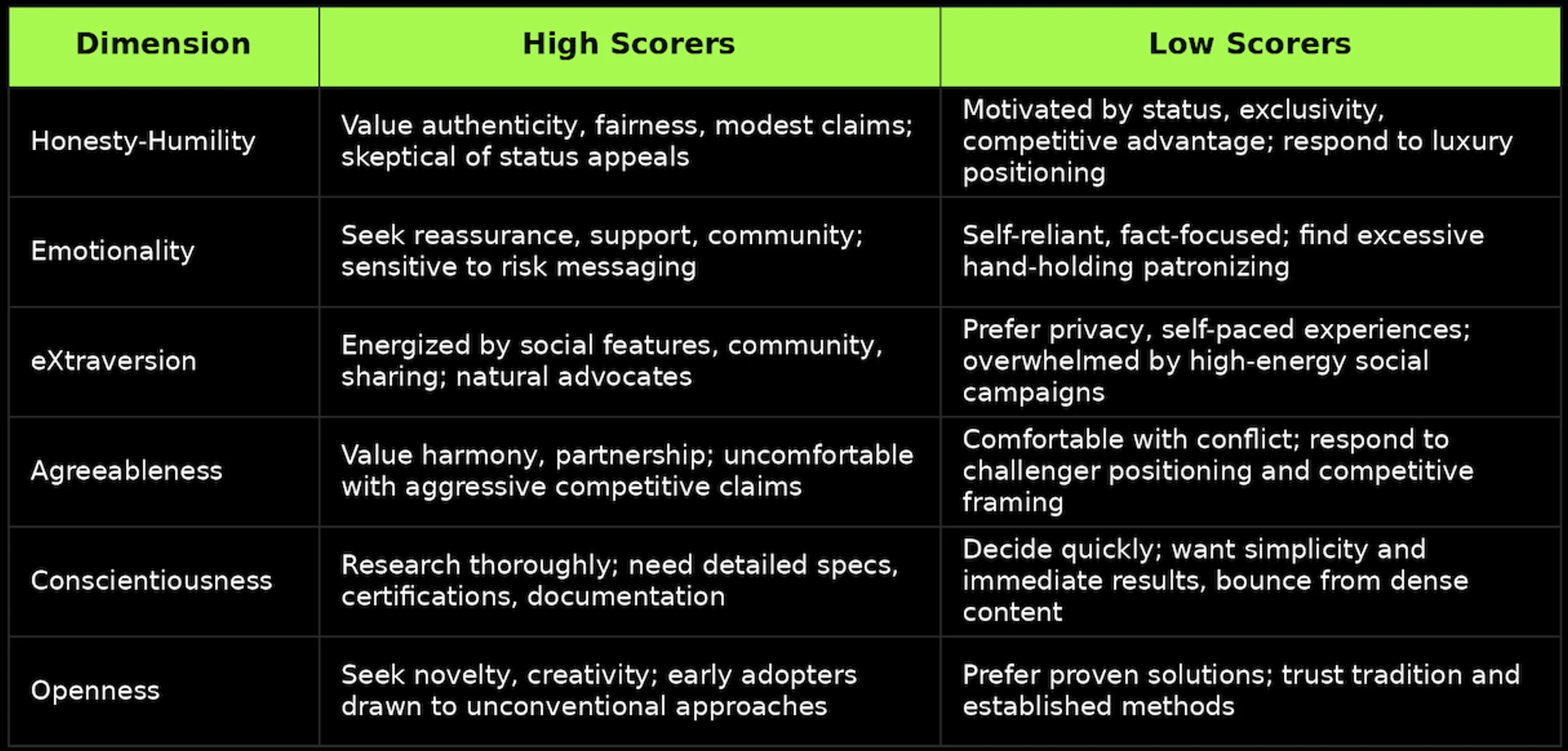
The key insight: the same product benefit can and should be framed differently depending on which profiles dominate your target segment. A financial product might emphasize "security and peace of mind" to high-Emotionality audiences while leading with "maximum returns and performance" to low-Emotionality segments. Same product, different psychological entry points.
Honesty-Humility: The Highest-Stakes Dimension
Research shows Honesty-Humility is the single strongest predictor of brand trust, perceived quality, and loyalty. Misalignment here doesn't just hurt campaign performance, but also damages the brand relationship.
Messaging for High Honesty-Humility
Psychology: These consumers are allergic to manipulation and see through flattery. Status symbols hold little appeal; they want genuine value and transparent practices.
Tone: Straightforward, unpretentious. Avoid superlatives and exclusive positioning.
Emphasize: Transparent pricing, ethical sourcing, real customer stories, fair trade, quality-for-money.
Example Angle: "No hidden fees. No inflated claims. Just [product] that works, priced fairly. Here's exactly what you get."
Messaging for Low Honesty-Humility
Psychology: Motivated by status, material success, and competitive edge. They respond to exclusivity and signals that elevate them above others.
Tone: Aspirational, premium. Create desire through scarcity and status.
Emphasize: Limited availability, VIP access, luxury associations, prestige, competitive advantage.
Example Angle: "Reserved for the select few who refuse to settle. Limited to 200 members. Apply for consideration."
Emotionality: Security vs. Performance
This dimension shapes how consumers process risk and make decisions under uncertainty. Get the calibration wrong, and you either fail to reassure anxious buyers or patronize self-reliant ones.
Messaging for High Emotionality
Psychology: These consumers feel anxiety around decisions and seek emotional support. They form strong attachments to brands that "get" them.
Tone: Warm, reassuring, empathetic. Acknowledge concerns before addressing them.
Emphasize: Guarantees, responsive support, community, safety nets, peace of mind.
Example Angle: "We know switching feels risky. That's why we offer a 90-day full refund, 24/7 support, and a community of 50,000 members who've been exactly where you are."
Messaging for Low Emotionality
Psychology: Self-reliant and unimpressed by emotional appeals. They want facts, not feelings. Excessive reassurance feels patronizing.
Tone: Direct, confident, efficient. Respect their capability to evaluate information themselves.
Emphasize: Performance metrics, efficiency, capability, self-service options.
Example Angle: "2.3x faster processing. 99.9% uptime. Full API access. The specs speak for themselves."
eXtraversion: Social vs. Personal
Extraversion determines whether your audience sees social features as a benefit or a burden and predicts engagement with community-building efforts.
Messaging for High Extraversion
Psychology: Thrive on social connection. Energized by group experiences and want to be part of something bigger.
Tone: Energetic, social, engaging. Create FOMO around community experiences.
Emphasize: Community access, events, networking, sharing features, collective experiences.
Example Angle: "Join 10,000+ members at our next virtual summit. Share your wins. Connect with peers who get it."
Messaging for Low Extraversion
Psychology: Prefer self-directed experiences. Social pressure feels uncomfortable. They want to engage on their own terms.
Tone: Calm, respectful, unhurried. No pressure, no crowds.
Emphasize: Privacy, customization, self-paced options, one-on-one support, personal control.
Example Angle: "Your space. Your pace. Complete access to every resource, ready when you are. No group calls required."
Agreeableness: Collaboration vs. Competition
This dimension shapes response to competitive messaging. Some audiences love a challenger brand; others cringe at conflict.
Messaging for High Agreeableness
Psychology: Value harmony and cooperation. Aggressive competitive claims feel off-putting.
Tone: Cooperative, gentle, inviting. Position as a partner, not a warrior.
Emphasize: Partnership, mutual benefit, working together, relationship.
Example Angle: "Let's build this together. Your success is our success. We're partners in what comes next."
Messaging for Low Agreeableness
Psychology: Comfortable with conflict and competition. Respect brands that take a stand.
Tone: Bold, competitive, challenger. Don't be afraid to call out the status quo.
Emphasize: Competitive advantage, winning, beating alternatives, disruption.
Example Angle: "While they're stuck in last decade's playbook, you'll be three moves ahead. It's not even close."
Conscientiousness: Detail vs. Simplicity
This dimension predicts information-seeking behavior and determines whether your landing page converts or overwhelms.
Messaging for High Conscientiousness
Psychology: Thorough decision-makers who want complete information. They appreciate precision and distrust vague claims.
Tone: Precise, detailed, thorough. Provide evidence for every claim.
Emphasize: Specifications, certifications, testing data, comparisons, documentation.
Example Angle: "ISO 9001 certified. 47 quality checkpoints. Here's our complete spec sheet, testing methodology, and third-party audit results."
Messaging for Low Conscientiousness
Psychology: Want quick answers and easy decisions. Dense information overwhelms rather than reassures.
Tone: Simple, immediate, effortless. Remove friction at every step.
Emphasize: Ease of use, quick setup, instant results, minimal effort required.
Example Angle: "Set up in 2 minutes. Works immediately. No configuration required."
Openness: Innovation vs. Tradition
Openness predicts response to novelty. Research shows it's among the strongest correlates of pro-environmental attitudes, making it key for sustainability messaging.
Messaging for High Openness
Psychology: Seek novelty and intellectual stimulation. Early adopters who appreciate unconventional thinking.
Tone: Creative, curious, unconventional. Challenge assumptions.
Emphasize: Innovation, creativity, new approaches, experimentation, breaking conventions.
Example Angle: "We threw out the rulebook and started from first principles. Here's what we discovered when we asked: what if everything you assumed was wrong?"
Messaging for Low Openness
Psychology: Prefer proven approaches and familiar solutions. Innovation for its own sake doesn't impress them.
Tone: Classic, trusted, reliable. Emphasize track record.
Emphasize: Proven results, tradition, established methods, reliability, consistency.
Example Angle: "The same proven approach trusted by 10,000+ customers over 15 years. When it works, why change it?"
Working With Multiple Dimensions
Real audiences don't fall neatly into single-dimension buckets. Your target segment might skew high on Conscientiousness and high on Openness: detail-oriented innovators who want thorough documentation of new approaches.
The key is identifying which 2-3 dimensions are most relevant for your product category and audience. A luxury fashion brand might focus on Honesty-Humility and Openness. A B2B software company might prioritize Conscientiousness and Emotionality.
This is where understanding your audience's actual personality distribution becomes essential so you’re not guessing, but knowing. When you can model how your target segments score across dimensions, you develop messaging that hits the right combination of notes. And when you can test those message combinations against high-fidelity audience models before going to market, you're not gambling on creative intuition. You're validating hypotheses computationally, then deploying the combinations that resonate.
From Framing to Execution
Understanding how to frame messages is the foundation. But implementing personality-based messaging at scale like segmenting audiences, developing creative efficiently, and measuring impact requires operational systems.
In Part 2, we cover the implementation playbook: how to identify your audience's personality distribution, build modular creative systems that scale, and measure whether personality-message fit actually drives business outcomes.