
The Six HEXACO Factors and What They Reveal About Brand Personality
Joe Mendenhall | May 5, 2026 12:00 AM UTC
Overview
How your brand presents itself to the world, and how consumers interpret that presentation, is a manifestation of your brand’s personality. Think about the brands you interact with on a day to day basis. Are they more a brash Samantha, a sensitive Charlotte, a pragmatic Miranda, or a boring Carrie? A Buzzfeed-style ‘Sex and the City’ interpretation of brands is fun, but superficial. We can go much deeper by applying the HEXACO framework to your brand’s personality in order to better understand how you present to your audience, and how to optimize that presentation.
Takeaways
- Historically, Aaker’s Five-Factor model has been the authority for brand personality scaling, however HEXACO allows for an interpretation of brand personality that is more closely aligned with interpretations of your audience’s personality.
- Consumers tend to like brands that are aligned with their self-image, presenting the need to measure both audience and brand personality.
HEXACO for Brands
In 1997, Jennifer Aaker published her seminal paper which would become the benchmark for brand personality scaling, “Dimensions of brand personality.” In it, she rejects the typical Big Five OCEAN model (Openness, Conscientiousness, Extraversion, Agreeableness, Neuroticism) as a legitimate way to map brand personality, developing instead a five-factor framework with the traits of Sincerity, Excitement, Competence, Sophistication, Ruggedness. (A decidedly difficult string of words to acronymize, SECSR? RECSS?)
Though the scale was meant to exist beyond the Big Five model, Aaker admits in the paper that 3 of her 5 factors correspond to the Big Five model, with Agreeableness corresponding to Sincerity, Extraversion to Excitement, Conscientiousness to Competence. With two Aaker factors, Ruggedness and Sophistication, being absent from the Big Five framework, and the Big Five dimensions of Neuroticism and Openness being cut.
Thus, though Aaker repudiates the Big Five model as directly applicable to brand personality, her research indicates it (or at least 60% of it) does indeed accurately map onto Brand Personality.
Aaker was writing here in 1997, before the advent of HEXACO (and its overtaking of the Big Five model), and importantly, during a different era of brand presentation.
In our age of smart phones and social media, where every brand has an Instagram page that not only posts original content but also comments and reposts like an actual person, it’s easy to argue that brands are more personified than ever. Aaker’s scale, though relevant, is perhaps not as equipped to handle modern brand personality as HEXACO, and indeed researchers have found value in the application of HEXACO to map brand personality.
This is not to reject Aaker’s scale, but to highlight that a HEXACO application to brand personality has merit, and that Aaker’s scale is not the be-all end-all to understanding your brand’s personality.
What is the value in this?
You might be wondering, “why does brand HEXACO matter, and how does it relate to me and my brand?”
Research indicates that people tend to like brands that are more closely aligned with their self image. A mischievous person low in Honesty-Integrity is more likely to like a brand that presents itself as equally mischievous.
So, if you know your ideal audience’s HEXACO, and you know your Brand’s HEXACO, you can align your brand’s messaging to adapt its personality to your ideal audience.
A Quick Note on HEXACO and Methodology:
HEXACO is split into six different factors, and these factors correspond to different facets and traits. For example, Honesty-Humility in HEXACO is a factor (sometimes called a domain); a facet of Honesty-Humility is sincerity and a trait associated with Honest-Humility is trustworthiness.
In this Brand/HEXACO breakdown, we’ll focus on factors and traits, providing brand traits associated with each HEXACO factor.
The breakdowns below also provide brands that might exhibit particularly high scores within each factor. It’s worth remembering, however, that your brand personality doesn’t exist in just one factor, but is an ever-evolving combination of all HEXACO facets.
H- Honesty-Humility
Honesty-Humility, in people, inversely corresponds to how likely a person is to manipulate others, break rules, pursue material wealth, and value themselves highly.
Brands that are high in Honesty-Humility are respectable, genuine, and charitable.
A historical example of a high Honesty-Humility brand is Tom’s Shoes. Tom’s famous noughties pledge, that dominated their marketing for many years, to donate one pair of shoes per every pair of shoes purchased from them presents an almost unmatchably strong honesty-humility brand personality.
When we look at this Tom’s Shoes example, it’s easy to conceptualize how a brand’s HEXACO can draw in consumers whose self image aligns with that brand personality. Of course a high Honesty-Humility scorer would love to rock a pair of Tom’s, whereas someone of middling or low Honesty-Humility would be more likely to not care about that pledge.
E- Emotionality
Emotionality relates to how neurotic, or anxious, a person is.
In brands, low emotionality equates to being perceived as calm, composed. High emotionality brands are frenetic, nervous.
Dove is a quintessential high emotionality brand. Dove’s marketing efforts, drawing from their “gentle on skin” promise, exude that sense of calm and softness. A hand slowly glides dove over an arm. A whispery voice narrates. Some sort of flowy fabric drapes.
Ask yourself, would a person with their own inner calm seek that brand, or the raucous excitement of a skincare brand targeting teenage boys?
X- eXtraversion
Extraversion is an easy one- it relates to how outgoing and confident one is.
In brands, it manifests positively in such traits as liveliness, affability, and negatively in traits such as passivity and aloofness.
For a brand high-ranking in eXtraversion, look no further than Red Bull, whose sponsored death-defying stunts and general daredevil brand personality are the ultimate testament to an extraverted lifestyle.
Red Bull’s brand personality does not just lean into X-games style stunts, it goes further into the eXtraversion category by leveraging confidence in its marketing efforts. Red Bull events like the Soapbox challenge or the Flugtag challenge see amateur competitors adorned in silly costumes piloting outlandish vehicles. In other words, Red Bull’s marketing actively features normal, extraverted people doing extraverted things, seamlessly drawing that same type of personality into their fold.
A - Agreeableness
Agreeableness relates to how forgiving or lenient a person is (with anger being its inverse).
In brands, this corresponds to easygoingness, tolerance, or the inverse- coldness, acidity.
For a brand ranking high in agreeableness let’s pick a warm, family oriented brand- like Disney. In particular, let’s focus on Disney’s park arm (called Disney Experiences). Disney Experiences is all about welcoming and creating a home-away-from-home for all manner of people, and their marketing reflects this.
Take their recent "Infinite Worlds Await at Walt Disney World Resort” commercial as a case study. In this commercial, children and adults ranging from four to eighty-four say what sort of “World” Disney World is for them, “A World of Princesses”, “A World of Villains”, etc., etc. This diverse group of individuals gives a diverse range of responses, and throughout it all, cast members both literally and figuratively embrace them with open arms.
What’s important here is that Disney Experiences is not just positioning itself as a place where anything happens, but a place where anyone can do anything. The Disney Parks are being marketed as a place of acceptance, and if that’s your MO, you’ll be shelling out big bucks to eat Mickey Mouse shaped churros at a place where acceptance is positioned as the norm.
C- Conscientiousness
People who are conscientious are organized, disciplined, and deliberate.
In brands this leads to traits like diligence, or dependability. Rolex would be an example of a highly conscientious brand.
Rolex’s marketing is all about their impeccable craftsmanship, and the achievements of their customers. They specifically highlight individuals at the top of their crafts. World class athletes, actors, singers- these are Rolex ambassadors- people who themselves are disciplined and deliberate. Rolex’s strategy here is markedly different from that of a traditional brand partnership. Ads like their “The Height of Human Achievement”, published in Oct. 2025 and racking up almost 64 million views on YouTube at the time of this article, don’t feature their ambassadors espousing the strengths of the product, or even using the product.
Instead, this ad simply highlights these people operating at their peak. James Cameron dives to the bottom of the Mariana Trench. Tiger Woods lines up a shot. Rolex is saying: this is who our product is for, people like this- not demographically, but psychologically. They’re actively using the traits of their ambassadors to inform their own brand personality.
And if I’m someone with those traits myself, why wouldn’t I join the ranks of my kindred spirits and buy a Rolex?
O - Openness to Experience
A person who is Open to Experience is artistically minded, curious about the world, and nonjudgemental.
In brands, this manifests in traits such as creativity and curiosity. It negatively corresponds to old-fashionedness or conservatism.
Crocs are the perfect case study brand for high Openness to Experience. Croc’s whole game is anti-conservatism, anti-establishmentism. Old shoes are boring! Wear these rubber clogs instead!
Croc’s marketing efforts push this to the extreme, highlighting the brand’s creativity. They develop and market weird crocs: Croc stilettos, Shrek Crocs, Crocs with the most ungodly little “Gibbets” (their name for the charms that can be popped through the little Croc-holes on top of every shoe). Crocs have positioned themselves as the creative footwear brand, and thus the footwear brand for creative people.
HEXACO and Soulmates.ai
At this point, we’ve established how brand personality manifests itself in HEXACO format, and how people with similar HEXACO leanings find value in those brands, but now you might be wondering how this works in practice.
To go beyond the theory and into the practical, we need look no further than the Soulmates.ai platform.
Let’s do a small case study with Noah here, a gamer with the accompanying HEXACO profile, which was discerned from psychographic evaluations.
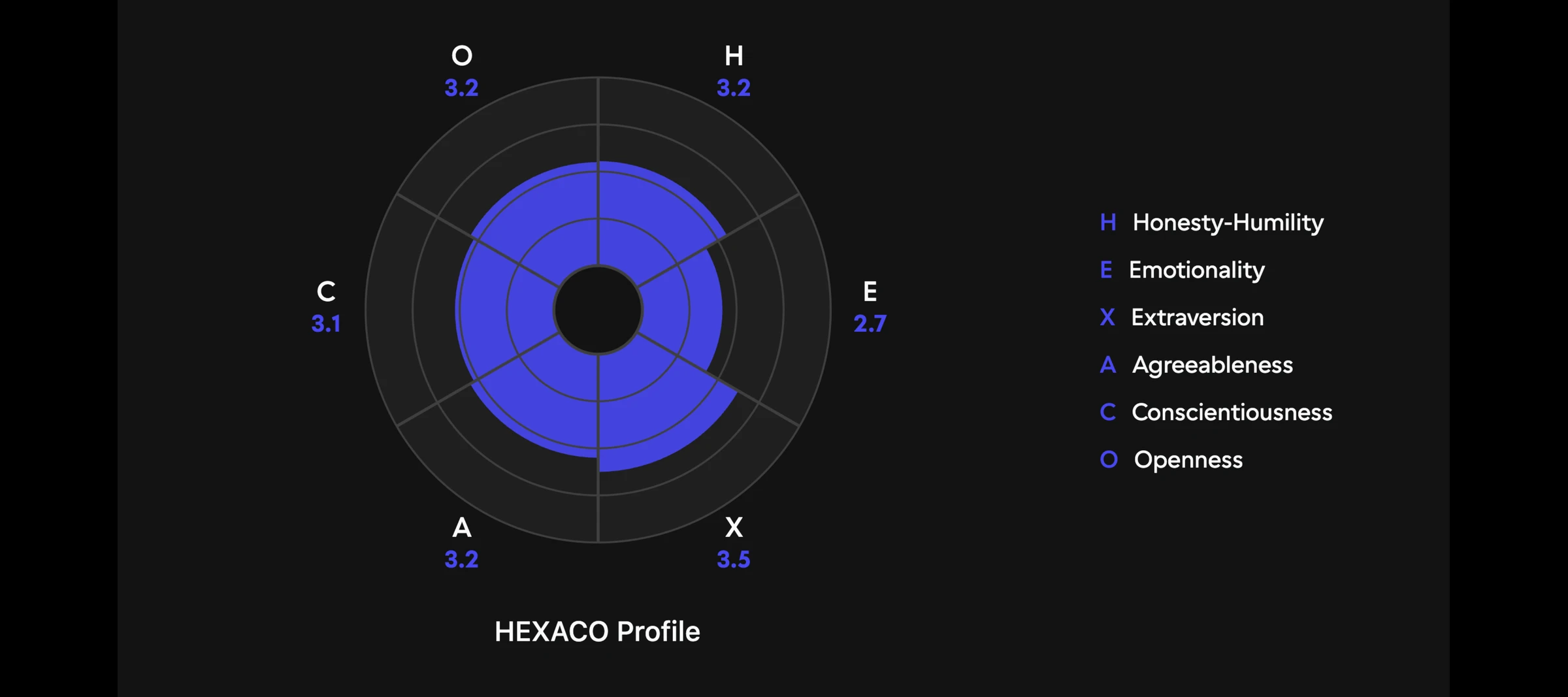
HEXACO is applied in a five point scale. Most people, like Noah, hover around the middle of that scale. Every .1 variation in score represents a pretty large shift in personality.
To determine your brand’s HEXACO breakdown, we can evaluate your brand’s visible personality using a process not dissimilar to the classic psychographic HEXACO evaluation.
Here, for example, is the HEXACO breakdown of a real brand we’ll give the alias Gamerz United (apologies if there’s a real Gamerz United).

Off the bat, you might notice that this brand's HEXACO scores are generally higher than Noah’s, hovering generally in the 4.0 range compared to Noah’s general 3.0 hovering. That’s to be expected since brands generally try to project a positive image of themselves, contrasting with the less-then-ideal reality of the human psyche.
Noah marks highly on the Extraversion scale of HEXACO, but Gamerz United has a comparatively middling Extraversion metric (reminder, Extraversion is the “X” is HEXACO). If Gamerz United were to try to attract Noah and people like Noah more readily to their brand, they might adjust their brand’s marketing efforts to reflect people being unabashedly confident.
Perhaps a showcase of cosplay photos on the Gamerz United Instagram page, or a partnership with a highly extraverted influencer.
This sort of message alignment is exactly what the HEXACO tools on the Soulmates.ai platform are designed for. With Soulmates.ai, you can bring your ideas to market confident that they align with your audience.
So what do you think, is your brand a Samantha? Is your audience? Those are probably easy to answer, but go deeper with HEXACO for a more nuanced understanding of your audience and your brand’s perception.
FAQ
Can HEXACO really predict consumer behavior?
Yes, studies have shown that psychographic profiling is an effective way to predict consumer behavior, especially in conjunction with demographics.
Is there still value in Aaker’s additional categories?
Yes! The brand personality domains of Ruggedness and Sophistication are still important in today’s understanding of brand personality. The use of a HEXACO framework as applied to your brand personality is not meant to supersede Aaker, but rather to add another dimension for measuring how consumers view your brand.