
How Gen Alpha Girls Feel About Sydney Sweeney's American Eagle Comeback
Lauren Arevalo | May 6, 2026 7:51 PM UTC

Overview
We queried 28 Brand Soulmates of Gen Alpha girls about American Eagle's "Syd for Short" summer 2026 campaign. Zero said they would boycott, 57% responded positively, 43% were neutral. The 2025 "Great Jeans" controversy did not reach this audience, and the cohort was able to meaningfully weigh in on an April strategy decision based on research fielded in January.
Takeaways
- Cultural controversy doesn't always reach the audience brands assume it does. For Gen Alpha girls, the AE x Sweeney "Great Jeans" debate was “adult news.”
- Continuity reads as confidence to this audience. Brands that double down on a creative choice can be rewarded for it, not penalized.
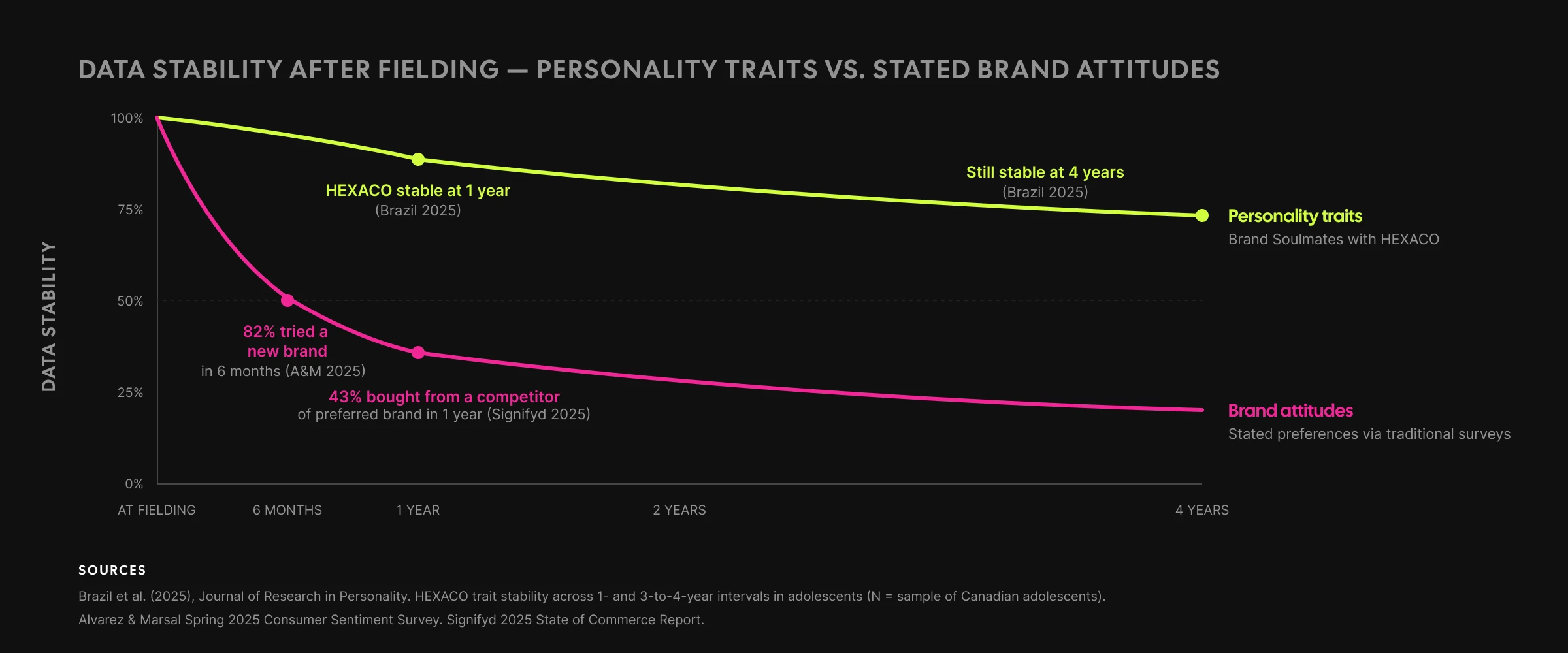
- HEXACO-anchored Brand Soulmates remain queryable months after fielding closes, because personality traits are stable on the timescale of months and years.
What Is AE's "Syd for Short" Campaign?
American Eagle launched "Syd for Short: American Eagle Jean Shorts" on April 15, 2026, as the brand's summer campaign and Sydney Sweeney's second consecutive partnership with the retailer. The campaign reframes Sweeney as "Syd," a more casual, beach-and-errands version of the actress, with sun-lit imagery, a self-aware tagline ("What brand am I wearing? Yeah, that one."), and 850+ new styles spanning low-rise shorties and micro skorts. A custom "Syd Jean" and "Syd Short" carry a butterfly detail that honors domestic violence survivors, with 100% of net proceeds from those styles going to Crisis Text Line.
This launch is the brand's first move with Sweeney since the 2025 "Sydney Sweeney Has Great Jeans" campaign, which generated 55 billion impressions, drove a +22% jump in AE's stock price, and became one of the most polarizing marketing moments of the year. The "great jeans / great genes" wordplay set off weeks of discourse about beauty standards, casting, and what AE was actually selling.
The question for any brand watching this play out is straightforward: did the controversy stick to the audience, or just to the headlines?
Soulmates.ai presents a way to find out without fielding new research.
How We Tested the Campaign
We queried 28 Brand Soulmates from the Gen Alpha audience cohort already live inside Soulmates.ai. All 28 are girls between the ages of 8 and 15. They were built from primary research conducted in January 2026 with 111 parent-consented households across 352 questions per persona, with parents responding alongside their children under a COPPA-compliant protocol.
We presented each Brand Soulmate with the "Syd for Short" creative, the campaign positioning, and context on the 2025 controversy. We asked them how they felt about American Eagle continuing to use Sweeney as the face of the brand, whether the prior controversy changed their view of the new campaign or the company, and what they noticed first.
What 28 Gen Alpha Girls Actually Said
Not a single Brand Soulmate in this cohort expressed a desire to boycott or avoid American Eagle. The full split:
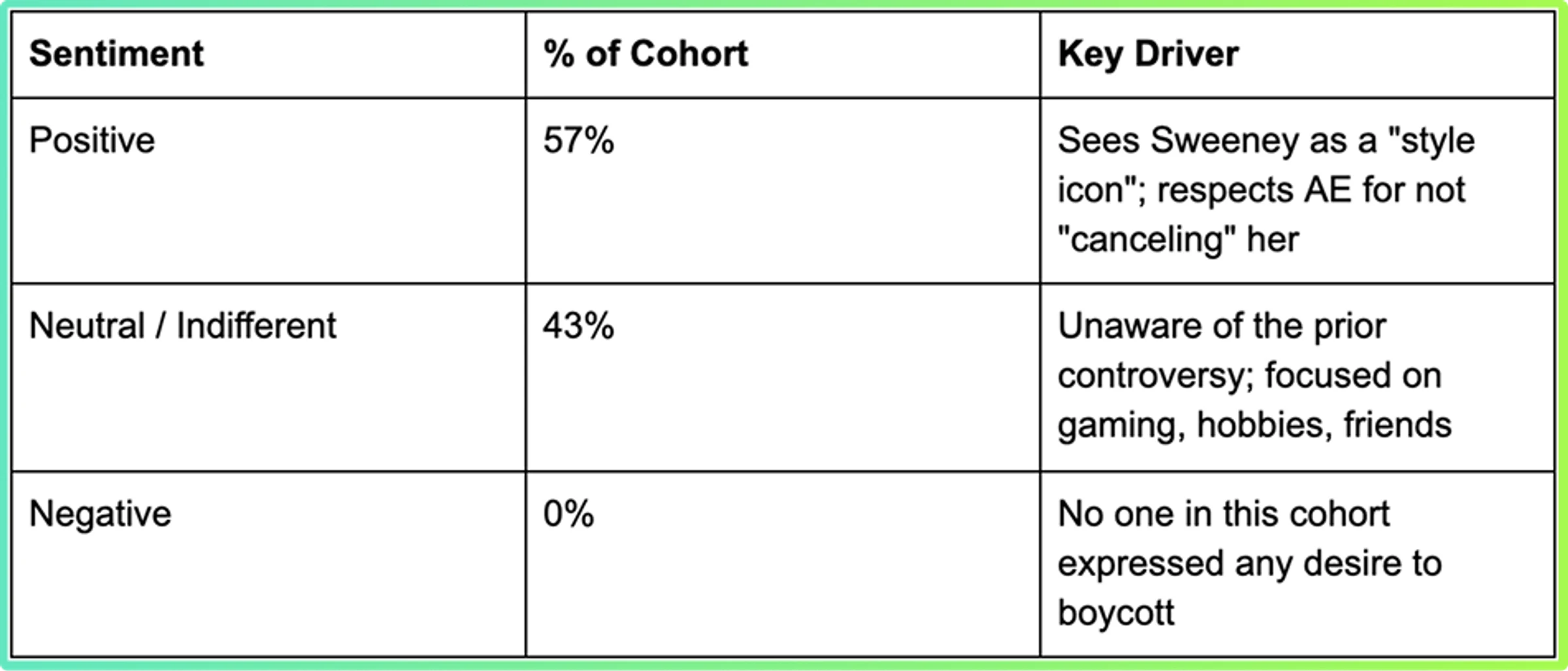
Three patterns came out of the qualitative responses, and they are more useful than the percentages.
- The drama is “adult news.” The controversy lives in headlines and group chats this audience does not read. One Brand Soulmate put it directly: "The internet drama feels like 'adult news.' None of my friends are talking about the captions, we're just looking at the outfits." Another: "I honestly don't get why people are mad? She looks good in the jeans, the jeans look good on her. It's not that deep. If the fit is fire, I'm buying it."
- Continuity reads as confidence The Brand Soulmates who registered the 2025 backstory did not penalize AE for bringing Sweeney back. They credited the brand for it. "I actually respect AE for using her again. It shows they aren't scared of a few mean tweets. It makes the brand feel more 'main character' and less corporate." Another: "Switching to someone else would have made them look like they did something wrong, which they didn't."
- The Crisis Text Line tie-in lands as a moral anchor. The mental health partnership came up unprompted in several responses. "The mental health tie-in with Crisis Text Line is a nice touch. It makes the whole thing feel more authentic and less like they're just trying to go viral for the wrong reasons." The "Syd" framing read as more accessible than "Sydney." "I like 'Syd' better than 'Sydney.' It feels more like a person you'd actually hang out with at the beach than a celebrity in a high-fashion ad."
The 43% who registered as neutral are unreachable through cultural controversy as a lever. Their consideration set is built around product relevance, gaming, and what their friends already have. Outrage marketing does not move them. Product placement and creator endorsements do.
What Is a Brand Soulmate?
A Brand Soulmate is a 1:1 high-fidelity digital twin of a real, recruited human, built and validated by Soulmates.ai. Each twin is built from a single, distinct, individual. The twin is anchored to the HEXACO personality framework and trained on that respondent's full questionnaire, then validated against held-out answers from the same human.
Each Brand Soulmate carries its own fidelity score, visible inside the platform alongside its demographics and HEXACO traits. The average fidelity across the Brand Soulmates library is 93%. When you select a cohort, you filter the way you would filter any audience: by age, geography, HEXACO dimension, and fidelity score. If a question is high-stakes, you can filter to the highest-scoring twins. If you want a representative read, you query at the average. The control sits with the user.
Most "digital twins" in market today are composites: averages of panel data, lookalike models, or synthesized personas with no traceable human behind them. Brand Soulmates are not composites. When you query a Brand Soulmate, you are querying a model whose behavior has been tuned and tested to mirror one specific real person from your intended audience.
A panel goes stale the day fielding closes, but Brand Soulmates stay queryable.
Why January's Research Speaks to an April Question
Audience research has a reputation for going stale — fair, since behaviors and trends shift quickly. HEXACO sits underneath that layer. It scores how a person processes the world: how they weigh fairness, react to authority, tolerate novelty, and regulate emotion. Those traits hold up over years, which is why a Brand Soulmate fielded in January can answer an April question.
The rank-order stability of HEXACO traits has been replicated in adolescents specifically, the exact age range our cohort covers. A 2025 longitudinal study published in the Journal of Research in Personality tracked HEXACO traits in adolescents across three waves spanning four years and found stability across both 1-year and 3-to-4-year intervals. A larger 2022 meta-analysis covering nearly 180,000 participants confirmed the broader pattern: traits hold up over years, not weeks. Stated brand attitudes look nothing like that. According to the Alvarez & Marsal Spring 2025 Consumer Sentiment Survey, 82% of consumers had tried at least one new food or beverage brand in the past six months alone. Personality is on fairly stable ground, but brand attitudes are like the weather system on top of it. This is why a Brand Soulmate created in January is still useful four months later and beyond.
When we asked the cohort how they felt about AE doubling down on Sweeney, we were not asking them to predict a behavior they had never thought about. We were asking models with deeply scored Honesty-Humility, Emotionality, and Openness traits to react to a specific stimulus (in this case the recent Sydney Sweeney ad). The audience traits are constant, it’s the cultural shifts that are variable. Map those traits, and you can track how they respond to any stimulus.
Brands no longer are paying for just a snapshot of their audience at a given time. Instead, they can buy an instrument that can be pointed at whatever cultural moment, creative concept, or partnership decision lands on your desk next quarter. The American Eagle question we ran could have been asked about a Spotify campaign, a Nike collab, a Roblox brand integration, or a TikTok trend. The cohort would be able to lend its insights in unique ways to every unique case.
What This Means If You're a Brand Marketing to Generation Alpha
A few takeaways that travel beyond AE.
- Cultural controversy doesn't always reach the audience you think it reaches. Marketing teams write campaign briefs assuming a level of cultural fluency in the target. For Gen Alpha, that fluency is selective. They are deeply embedded in some cultural conversations, like Roblox skins, MrBeast videos, and creator drama. They are notably absent from others. Before you over-correct on a "controversial" choice, find out whether the people you are worried about are actually in the conversation.
- Continuity has a tone the audience can read. Reactivity reads as guilt. Consistency reads as confidence. The Brand Soulmates who registered the 2025 backstory rewarded AE for continuity. That maps to a value set that ranks fairness and consistency near the top of how Gen Alpha evaluates the adult world. The Understanding Gen Alpha report found that 95% of Gen Alpha rank protecting people from bullies as their top value, above helping people, equality, and family approval. A brand that is perceived to have buckled to a "mean tweet" pile-on is on the wrong side of that values map.
- Cause-aligned philanthropy is not a gimmick to this cohort. Crisis Text Line as a beneficiary worked because mental health is one of the cultural topics this generation is fluent in. A different beneficiary, less aligned with their lived experience, would not have carried the same weight. Match the cause to the cohort.
- Most importantly: research that ages well is research that was built to. The reason we could answer an April question with January data is that the research was scoped from day one to support ongoing inquiry, not one-off reporting. If your audience research goes in a deck and stays in a deck, you are paying for a snapshot. If it goes into a system, you are paying for a capability.
FAQ
What is Soulmates.ai? Soulmates.ai is an AI audience intelligence platform that builds 1:1 high-fidelity digital twins of real, recruited humans. The platform allows brands to pressure-test creative, messaging, partnerships, and strategy decisions against real audience psychology before committing budget.
What is a Brand Soulmate? A Brand Soulmate is a 1:1 digital twin of a real respondent, anchored to the HEXACO personality framework and validated against held-out answers from the same human it was modeled on. Each Brand Soulmate has its own fidelity score, visible in the platform alongside demographics and HEXACO traits. The average fidelity score across the Brand Soulmates library is 93%.
Is Soulmates.ai's Gen Alpha research COPPA-compliant? Yes. The methodology was designed for COPPA compliance from the recruitment stage forward. Parents and guardians consented to participation, parents responded alongside their children for the duration of the survey, and no data was collected from a minor without verified parental consent. The Children's Online Privacy Protection Act requires verifiable parental consent for collecting personal information from children under 13, and Soulmates.ai's protocol applies that standard across the entire 8-to-15 age range covered by the cohort. This matters because most "Gen Alpha audience insights" in market today are inferred from secondary social listening data, scraped behavioral signals, or panels that quietly skirt the consent question. Brand Soulmates of minors only exist in the Soulmates.ai platform because parents signed their kids up to participate.
How is a Brand Soulmate different from a persona? A persona is a representation of a group of people with shared commonalities. A Brand Soulmate is a representation of one specific person, built from that person's actual responses and validated against their held-out answers. Personas describe groups. Brand Soulmates mirror individuals.
What is HEXACO and why does it matter for marketing research? HEXACO is a six-dimension personality framework (Honesty-Humility, Emotionality, eXtraversion, Agreeableness, Conscientiousness, Openness) developed by personality psychologists Kibeom Lee and Michael Ashton. It expands on the more familiar Big Five model by adding Honesty-Humility as a sixth dimension, which is a strong predictor of brand trust. HEXACO traits are stable over months and years, which is why a Brand Soulmate built from HEXACO data can answer a question about a campaign that did not exist when the original research was conducted.
Why did the Sydney Sweeney "Great Jeans" controversy not affect Gen Alpha girls? Because the controversy lived in adult news cycles and corporate media discourse, not in the cultural channels Gen Alpha actually inhabits. According to the Soulmates.ai Gen Alpha cohort, this audience filters cultural noise through their consideration set, which is dominated by gaming, creators, and peer word-of-mouth. The "Great Jeans" wordplay debate did not enter that filter for most participants.
Can I test my own brand's campaign against the Gen Alpha cohort? Yes. The Gen Alpha audience cohort is part of the Brand Soulmates audience library available to all Soulmates.ai platform clients, including a free trial built around this exact use case. You can also commission custom Brand Soulmates of your own audience.
Big decisions deserve better than instinct.
The Gen Alpha cohort is part of the Brand Soulmates audience library inside Soulmates.ai, available to all platform clients. The original research was conducted with 111 parent-consented households in January 2026 in partnership with eMarketer. To see the full Gen Alpha report or query the cohort against your own creative, start a free trial.